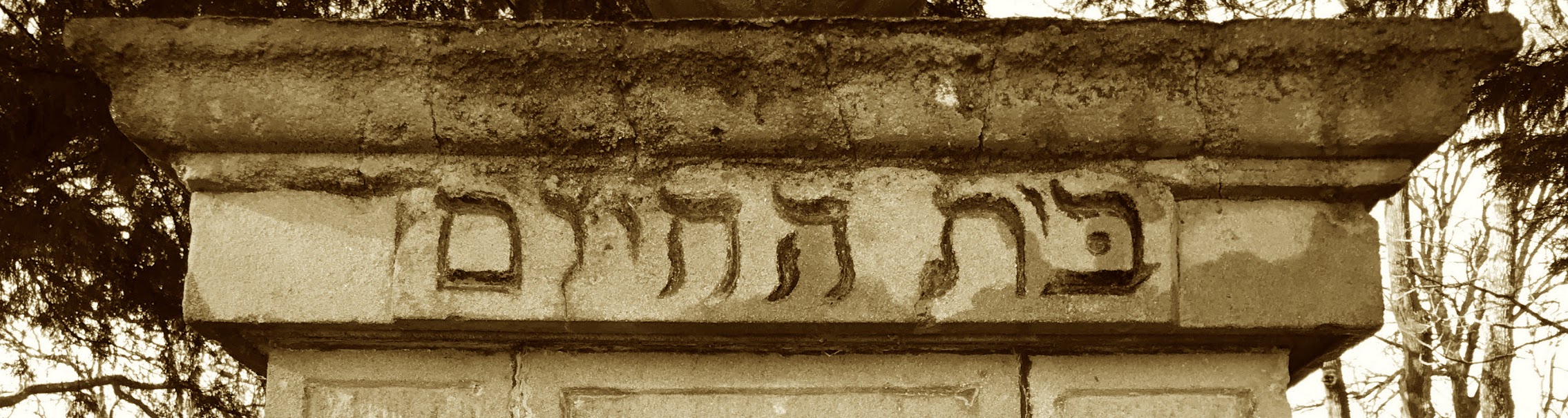
For information about the Pioneer Jewish experience Click:
Early Jewish History of Victoria
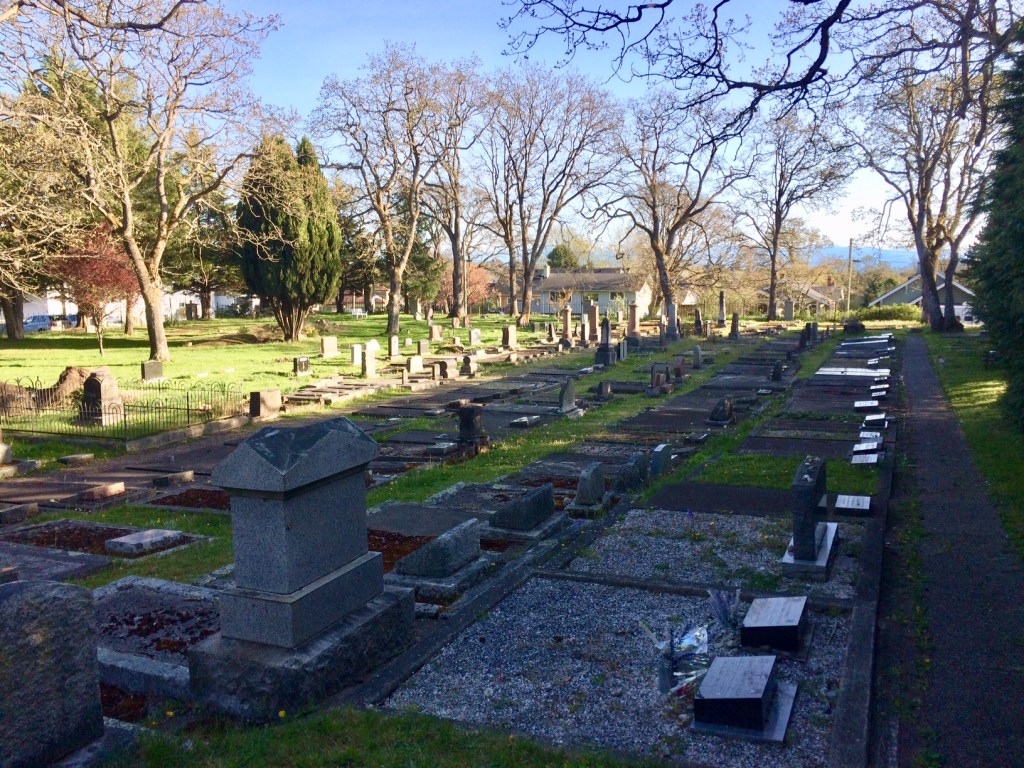
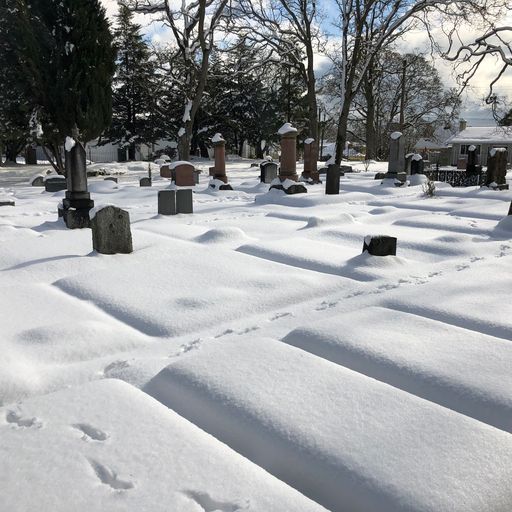

The Jewish Cemetery of Victoria was established in 1860 atop a hill on the traditional and ancestral land of the Lekwungen speaking peoples in what is now Victoria, British Columbia and is now the oldest non-Indigenous cemetery still in use in the province.
Europeans settled in Victoria in 1843 when the Hudson Bay Company transferred its western headquarters from Ft. Vancouver, Washington, to Victoria. The Colony of Vancouver Island was established in 1849. The history of western Canada was changed when gold was discovered on the mainland Colony of British Columbia in 1858. This discovery coincided with the end of the California gold rush and thousands of prospectors were itching for the next gold strike.
The summer of 1858 saw 20,000 to 30,000 people flood through Victoria on their way to the mainland goldfields, with a number of Jews among them. This small population of Jews included; travelling salesmen, farmers, and adventurers who would try their hand in the goldfields, but the vast majority came as merchants.
In 1859, some Jewish men gathered at Katy Gambitz’s dry goods store on Yates Street in downtown Victoria, and founded the Hebrew Benevolent Society. The Society created a committee to oversee the creation of a Jewish Cemetery and another to build a house of worship. The creation of the Jewish Cemetery in 1860 preceded the 1863 establishment of the synagogue building at the corner of Blanshard and Pandora Streets.
On October 1, 1859, the Weekly Victoria Gazette reported that 0.7 hectares of land was purchased from the Hudson Bay Company’s Chief Factor, Roderick Finlayson, as a “suitable site” for the cemetery. While these merchants knew a lot about business, their geological knowledge was lacking; they failed to consider the potential problems for a cemetery when purchasing land on the top of a hill with bedrock showing.
In February 1860, the first Jewish cemetery in western Canada was created in Victoria. People gathered at the Royal Hotel on Wharf Street and made their way to Cedar Hill Road. In those days, the trip would have taken about an hour and a half. Carriages entered the site through the main gate, and pedestrians came through two smaller Gothic style gates. The Vice President of the Society began the ceremony by calling out in Hebrew “Open the Gates of Heaven.” Members of the Hebrew Benevolent Society then formed a double line and walked around the site three times, reciting Psalms.
The original gate was designed by architect Edward Mallandaine. It was alternating white and black wooden picket fence. By 1863 the fence required the first of many repairs. At various times, wooden slatted fences and a chain link fence have surrounded the cemetery.
Early history of the cemetery is sketchy as two naturally occurring grass fires destroyed some the wooden fencing and many of the early wood markers and some of the cemetery records that were in a shed on the site. The first fire occurred in 1869. According to the The Daily Colonist on July 22, 1869,
“the fence and brush at the Jewish Cemetery were in flames and Messrs F.W. Feyser and H.M. Cohen (manager of the cemetery) proceeded to the spot in a buggy… They arrived in time to save a great portion of the fence and extinguish the fire before it had reached railings surrounding the graves. The damage done was about $80.”
On September 13, 1890 the The Daily Colonist reported:
“About an hour before noon yesterday a grass fire which had been smouldering during the night burst into activity in the neighbourhood of the Jewish cemetery, on Cedar Hill road. The fire found fresh and more substantial fuel in the fences and soon began to assume serious proportions. It was first noticed by Messrs B. Williams and E. J. Salmon, who were in the neighbourhood.”
The men worked for “an hour or more trying to beat out the flames and keep them under control until help could arrive. In this only partial success was achieved. The flames seized upon the tall grass and soon swept over the 30 or more graves in the cemetery, destroying the head and foot-boards, ruining the flowers and where there were marble headstones or monuments doing them considerable damage.”
E.J. Salmon’s hands got burnt as he attempted to extinguish the fire.
Although the cemetery was beyond the city limits at that time, the Victoria Fire Department responded to the call. The fire was brought under control by 1:30 p.m. Two of the fire fighters equipped with fire extinguishers were left to guard the site for the remainder of the day.
Documents which survived the fires contained names and plot numbers of the buried, but the orientation of row numbers is unknown. A map drawn in 1949 numbered the graves in ascending order from right to left, the way Hebrew is read. A 1938 record was used by architect Ben Levinson as the basis for his plans and his map drawn in 1991 numbered the plots the opposite way. It is unclear when the numbering system was changed. It might have happened when Levinson was working with architect Karen Hillel in the early 1990’s.
A call for tenders to paint the fence at the cemetery was published in The Daily Colonist on May 5, 1871. The advertisement read:
“Sealed tenders will be received until Friday the 12th of May for painting the Jewish Synagogue and the Jewish Cemetery Fence, specifications for same to be seen at Mr. Lewis Lewis’ store Yates Street. The lowest or any tender not necessarily accepted.”
According to The Daily Colonist on January 19, 1881, “A handsome monumental shaft about 15 feet in height resting on a granite base has been carved from Beaver Cove marble by Mortimer & Reed to the memory of the late J.P. Davies at the Jewish Cemetery and is one of the most beautiful pieces of monumental work we have met in the country.”
Maintaining the cemetery through the early years was difficult as the economic climate of Victoria shifted and the Jewish population ebbed and flowed. As a result, for many years the cemetery suffered from neglect.
At Congregation Emanuel-El’s 1895 Annual General Meeting, a committee of five was appointed to purchase land for a new site for the cemetery. On August 30, 1895, The Daily Colonist reported that a three-acre site close to Ross Bay Cemetery was under consideration. The article stated:
“To the new acreage the dead now buried in the Jewish cemetery on Cedar Hill Road will be removed by the congregation, except in cases where relatives claim them and bear the expense. A number of the bodies when exhumed for re-burial will however be taken to other cities including San Francisco and Seattle. The new cemetery will be immediately taken possession of so that the transfer of the bodies may be affected at the earliest possible date. When this is done, the old site will be offered for sale.”
Instead, the Hebrew Ladies Society took charge of the site on Cedar Hill Road. They began their work in 1895. Prominent architect Thomas Hooper put an advertisement for Tenders for “grading of walks and driveways and surface drains of the Jewish Cemetery.” in the October 1, 1897 edition of The Daily Colonist.
In 1899 under the Hebrew Ladies Society direction, Jewish businessmen H. Herschel Cohen and Sol Oppenheimer donated funds. In an attempt to beautify the cemetery, Auctioneer Joshua Davies contributed plants, and his nephew Samuel Schultz (journalist, composer, star baseball pitcher and the first Jewish Judge in Canada) provided labour. However, upkeep of the cemetery was abandoned due to an economic collapse in Victoria in the early 1900’s.
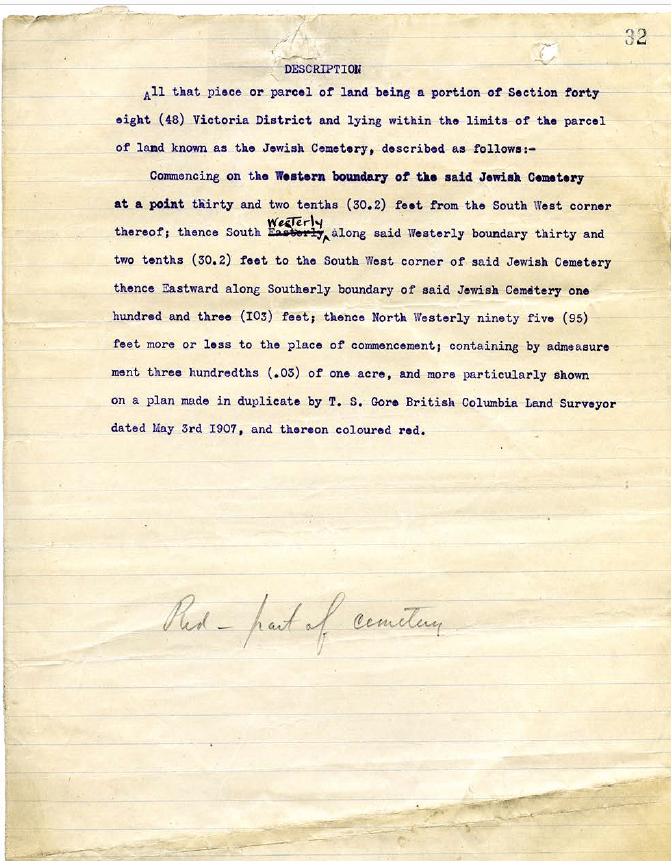
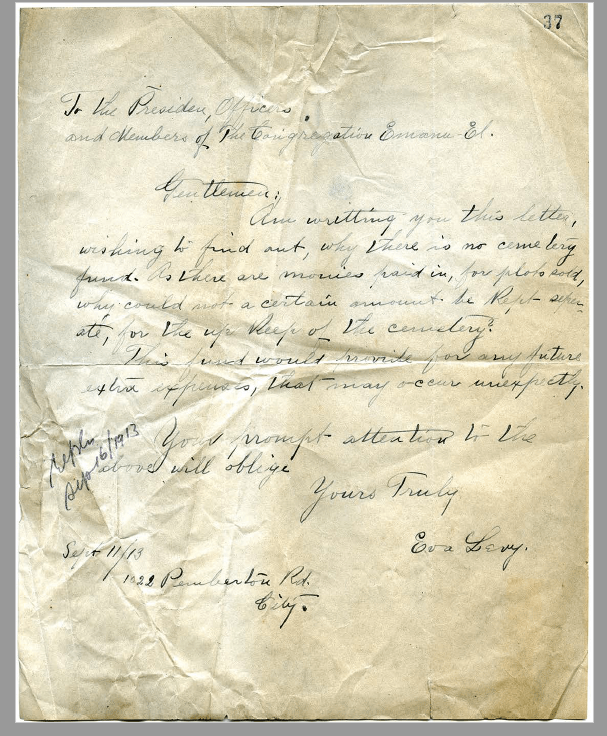
By mid-twentieth century, the grounds were overgrown. Some monuments remained but many of the graves had been denoted by wooden markers. Those which survived the fires were rotten or deteriorated and lay strewn throughout the cemetery. Due to the level of neglect there was talk again of abandoning the site and moving the cemetery to Royal Roads. Instead, in 1948 Alice Mallek, then the only woman in the Victoria Chamber of Commerce and the first woman to be president of Congregation Emanu-el established the Cemetery Trust Fund independent of Congregation Emanu-El.
With Sidney Levy and Morris Greene, Alice Mallek organized a Cemetery Committee. They arranged to have the cemetery cleaned, gravestones remarked, the road improved, and new gates installed. In those days there weren’t many burials in the cemetery as people chose to be buried either in Vancouver or in the cities where they had previously lived. In 1910 there were 29 burials, 27 in the 1920’s, 25 in the 1930’s, 16 in the 1940’s and 6 in the 1950’s.
In the late 1950’s, Leon Shaffer became interested in the cemetery’s historical significance and recruited his friend and recent arrival from Edmonton, Harry Brown, to help him. Leon Shaffer died not long after and Harry Brown took the reins.
Ben Levinson became involved with the cemetery in 1966. The entrance gates have been in place since that time or before. Morris Greene then owner of Capital Iron was in charge of the cemetery and he turned the work over to Ben Levinson. It was he who stopped Harry Brown from using abrasives cleaning products on the gravestones. Ben Levinson also took photographs of all of the graves.
Willie Jacobs, a Polish survivor of Auschwitz, was instrumental in the creation of the cemetery’s Holocaust Memorial. It was built by Syd Fry, owner of Brock Masonry and dedicated on May 3, 1981. In 2001, the memorial was restored and the ramp was added. Ben Levinson designed the area around the Holocaust Memorial.
In 1982 the newly appointed Rabbi Victor Reinstein of Congregation Emanu-El created the Chevrah Kadisha (Jewish ritual burial society) with Michael Goldberg as the chair. Rabbi Victor and Harry Brown were the Cemetery Committee for several years and created policies which still exist. The Cemetery Committee is now a sub-committee of the Board of Congregation Emanu-El. The Cemetery Trust fund continues to exists as a separate organization which helps to fund special projects and holds the reserve funds for perpetual care when the cemetery is full.
In the spring of 1993, Ben Levinson of Benjamin Bryce Levinson Architects and Planners designed the stone post and metal infill fence. Posts joined together by a low wall was replaced by the current see through metal fence, allowing police, neighbours and passerby’s to see into the cemetery. The new fencing was built by Max Josephson whose company also built the addition to Congregation Emanu-El’s synagogue building.
Ben Levinson working with Morris Green created the initial cemetery plan which was presented to the Cemetery Committee in 1966. The plan was revised in 1971 in collaboration with the architect Alan Hodgson (Hodgson and Levinson Architects). Another revision was done in 1978 by Ben Levinson in collaboration with Peter Orme (Orme and Levinson Architects). In 1991 Ben Levinson upgraded the plan with Karen Hillel. Don and Sheila Thompson of Piesces Garden Works submitted the next plan. Ben Levinson revised and presented a plan in 2005 which took into account future burial prospects.
In 2000, Geoffrey Perkins was hired as caretaker, and his partner Joy Wilkins began to help as a volunteer in 2004. Geoffrey Perkins stopped working at the Jewish Cemetery not long after Joy’s death on July 29, 2019. He died on January 27, 2022.
According to the Cemetery Committee Report of May 2001, a plan to create pathways was developed so that people using mobility devices could access graves. The plan was delayed to address issues with the irrigation system.
An irrigation system was installed in the cemetery in 2003 and updated in 2016 and again in 2021.
On December 30, 2011, the caretaker, Geoffrey, discovered that 5 graves had been desecrated. Some were spray painted with swastikas, one had been defaced with a white power symbol as well as with the words “Jewish scum.” As the monuments were being cleaned, they were wrapped in a see through cloth which made them look like they had been wounded in battle.
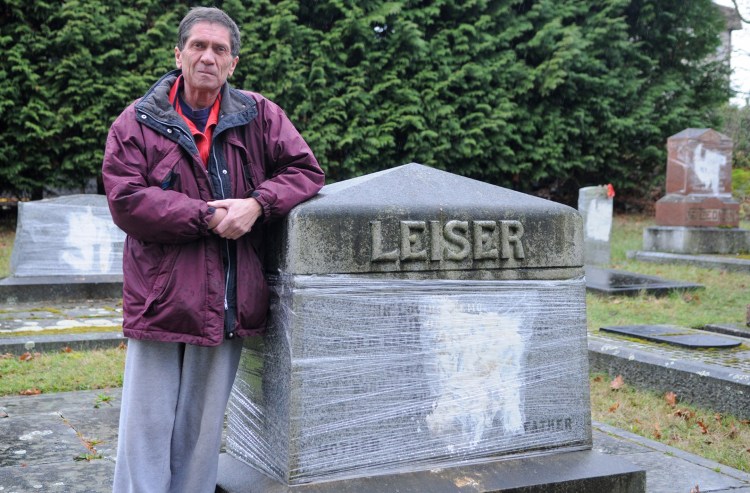
The graves which were damaged were those of: Charles A. Freedman, PTE Joseph Louis Vince, Eli Bean, Annabelle Bean, the monument for Caroline and Simon Leiser and their daughter Jennie, the monument for Gus Leiser, Clara Leiser, Max Leiser. In response, the following Sunday, six days after the vandalism, over 600 people, both Jews and non-Jews, gathered at the cemetery for a “Vigil of Respect” conducted by Rabbi Harry Brechner of Congregation Emanu-El.
Rocky outcrops of bedrock and large boulders left by receding glaciers had been a longstanding problem for the Jewish Cemetery. This large spine of rocks accounted for a significant amount of space which could otherwise be used as grave sites. With a loan from the Jewish Cemetery Trust, in July 2016, much of the bedrock was blasted and removed. The resulting boulders were used to create a retaining wall now known as the Zachor Remembrance Wall.
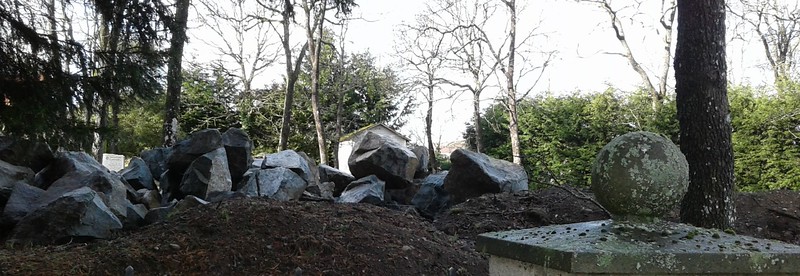
Although Jewish cemeteries don’t usually include Remembrance walls, Sydney Kalef and others wanted a place in Victoria to remember their family and friends who were either killed in the Holocaust or who are buried far away. In 2020 Sydney Kalef created “Friends of the Cemetery,” a volunteer gardening group. Sydney Kalef redesigned the landscaping for the cemetery entrance. A clear line of sight to better connect the Holocaust Memorial and the Zachor Wall was achieved by removing a row of Rhododendron that had lined the Holocaust Memorial side of the entrance. Rabbi Harry Brechner of Congregation Emanu-El led a dedication service for the Zachor Wall on October 17, 2021.
In 2015 Professor of Anthropology Erin-Lee McGuire from the University of Victoria began teaching field studies classes in the cemetery.
Through the use of modern technology, such as laser photography, Prof McGuire and her students have revealed inscriptions on the older gravestones which had been made illegible over time by wind, rain, lichen and moss. Some of their work is featured online at Picturing Cemeteries.
The question of burying non-Jewish spouses in the cemetery has been a contentious issue for a long time. A solution was proposed and adopted at an Annual General Meeting of the members of Congregation Emanu-El in March 2022. By acquiring city property along Cedar Hill Road from the cemetery gate to Ryan Street and incorporating it into the cemetery, there would be sufficient space outside the historic cemetery boundary, but inside the cemetery property line (the fence and property line are not the same) to bury both the Jewish and non-Jewish spouse.
The Board established a small committee lead by community member Michael Bloomfield (supported by Sydney Kalef, Bill Pechet and Cemetery Committee member Graham Dragushan to in shepherd this proposal on it’s path through City Council. Title to this “Triangle” was transferred to the Congregation on the 23rd of January 2024, and soon thereafter a fence was constructed.
Written by Amber Woods and Edited by Ben Levinson and Rick Kool

The Triangle History:
Written by Amber Woods and Edited by Graham Dragushan
The question of whether or not to bury Interfaith couples together in Congregation Emanu-El’s Jewish Cemetery swirled around this community for years. However, with many Jews reaching their sunset years, and Rabbi Harry Brechner’s evolving understanding of Jewish teachings, the issue took on more urgency around 2015.
Rabbi Harry then began a series of meetings to discuss the future of the Jewish Cemetery. After lengthy soul-searching and consultations with other rabbis and scholars, Rabbi Harry concluded that interfaith couples could be buried together in a specified part of the Cemetery which would be sectioned off by an established mechitza (separation). Listening circles were also hosted by Rabbi Harry to give people a chance to express their views. In February 2018, Rabbi Harry presented his Gezeirah or interpretation of the Halacha (Jewish Law).
While most of the people who attended meetings held on the subject were comfortable having non-Jewish spouses of long-time interfaith couples buried in the Cemetery beside their Jewish partners, there was a strong minority opinion who opposed that idea.
The core arguments expressed in favor of no change were:
- The idea that the cemetery was created by Jewish pioneers with the intention that the land be used to bury Jewish people.
- There is so little land owned by Jews in Victoria and around the world that giving up any part of the 0.7 hectare cemetery was viewed as too much of a sacrifice.
- If the non-Jewish spouse was so interested in being buried beside their partner, why did they not convert to Judaism and join the community when they were alive. Why wait until they died?
In response, Rabbi Harry and the Synagogue Board proposed a solution which respected the minority opinion. On the east side of the Cemetery was an unused area of the Cedar Hill Road right-of-way. Flanked by the cemetery fence and a sidewalk, the area contained a number of Garry Oak trees and a rocky outcrop.
Late in 2019, Rabbi Harry, Michael Bloomfield and Rick Kool met with the City’s mayor and officials to discuss acquisition of the unused part of the road right-of-way. Thus began the four year long process of acquiring the land. A small committee of Sydney Kalef (fundraising lead), Michael Bloomfield (City political lead) and Graham Dragushan (planning lead), took the helm and shepherded the process of acquiring the land. After four years, Congregation Emanu-El formally received title to the portion of the land in front of the cemetery from the city.
The section of land was referred to by the shorthand of the ‘Triangle’, a name that was officially recommended by Congregation Emanu-El’s Cemetery Committee in 2025.
However, Jennifer Karmona died on November 9, 2022, while the final arrangements to transfer title to the Triangle were still pending. She was a Jewish woman married to a non-Jewish man. As it happened, the existing fence around the Cemetery had been built some distance back from the property line. This meant that Jennifer could be buried outside the fence, but still on Cemetery property without offending those who opposed interfaith burials within the Cemetery.
In January of 2024, Congregation Emanu-El acquired full legal title to the Triangle, and in March, 2024 a fence was installed to enclose the newly acquired property. A formal path into the area and a new halachic (legal) separation are in development. The plan for interfaith burials is for double-depth burials. Ground Penetrating Radar (GPR) in 2023 prior to property acquisition, has also revealed sub-surface rock within the Triangle. This became more evident with the first burial of a non-Jewish spouse which took place in November, 2024 with the death of Brian Saunders.
The Triangle continues to be cared for by the Cemetery Committee on behalf of Congregation Emanu-El. In 2025 the section of the cemetery fence bordering the Triangle was removed. There will be an extension of the pebbled pathway to create the needed halachic mechitza (legal separation). Large Cypress trees are slated for removal in order to improve the chances of survival of one of the larger Garry Oak trees located within The Triangle. Plans for developing the area include, removing rock to prepare the land for double depth burials, and the option of plantings outside the fence to soften the view from the street.
 The Jewish Cemetery of Victoria, British Columbia